 Chunlei Mining Machinery
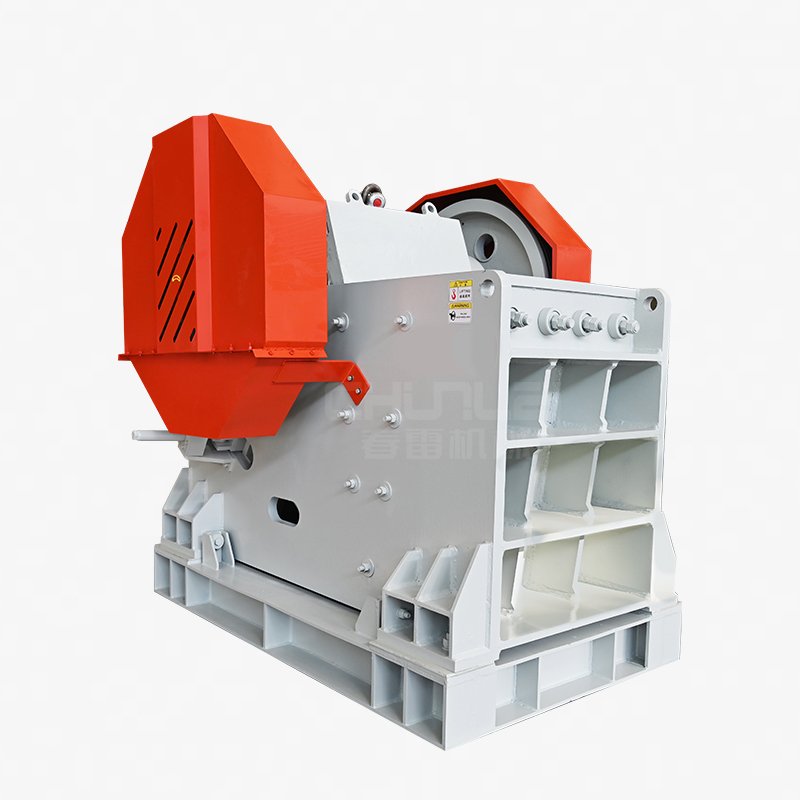


Jaw Crusher
Jaw Crusher is a commonly used ore crushing equipment, widely used in mining, smelting, building materials, highway, railroad, water conservancy and chemical industry and many other industries of the primary crushing equipment, mainly used for all kinds of ores and large materials with medium size crushing, and its compressive strength does not exceed 320 MPa.
- Feeding size:≤1200mm
- Capacity:3-1200t/h
- Applicable materials: It is suitable for coarse crushing of granite, marble, basalt, limestone, quartzite, river pebbles, iron ore, copper ore and other materials.
What is Jaw Crusher?
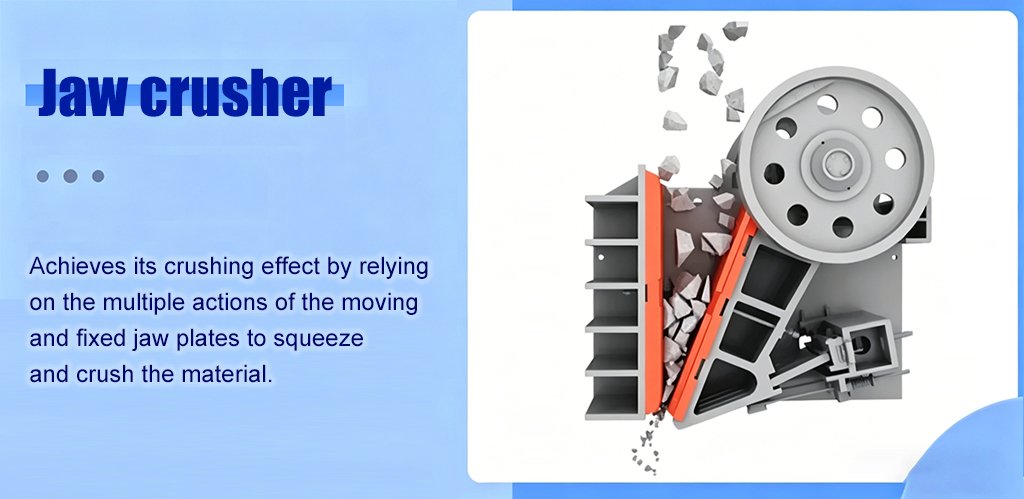
Jaw crushers are core primary crushing equipment in ore processing, quarry aggregate production, and construction waste recycling industries. They crush large rocks and ores into fine particles through the squeezing force between the fixed and moving jaw plates.
This equipment is primarily used for primary crushing in a complete crushing production line, often paired with cone crushers and impact crushers for secondary and tertiary crushing. Due to its simple structure, stable operation, and low failure rate, it is standard equipment in mining and quarrying projects. It is widely applicable to medium-hard and hard materials such as granite, basalt, iron ore, gold ore, copper ore, and limestone.
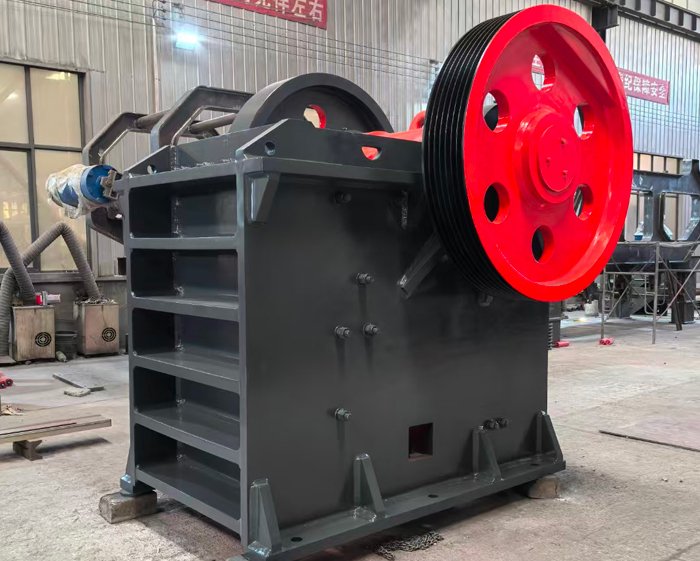
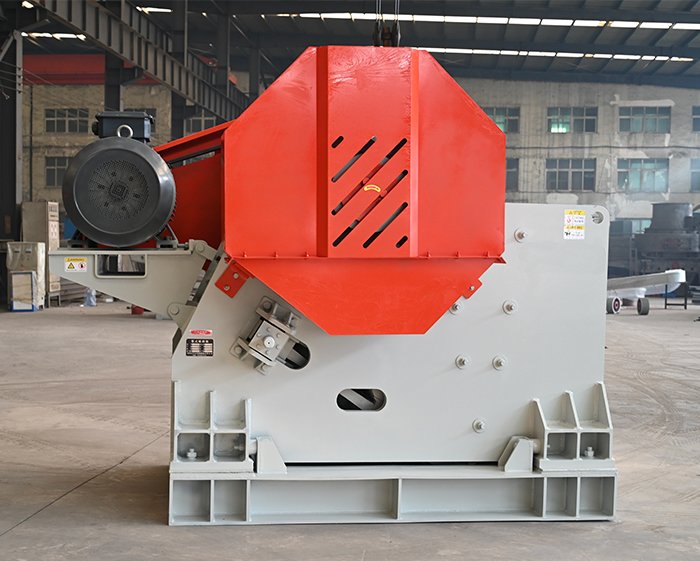
Our jaw crushers feature an integrated cast steel frame, an optimized deep crushing chamber, and high-manganese wear-resistant parts, offering advantages such as stable operation, high output, low energy consumption, and easy daily maintenance.
Jaw Crusher Classification
Based on mainstream market models and application scenarios, industrial jaw crushers are mainly divided into two categories: PE jaw crushers and CJ European-style jaw crushers. These two models have distinct structural characteristics and are applicable to different working conditions, facilitating precise selection for customers.
PE Jaw Crusher
As the mainstream coarse crushing equipment in the global mining and quarrying industry, the PE series jaw crusher serves the primary crushing needs of various medium-to-low hardness materials with its high cost-effectiveness and stable performance.
- Equipment Positioning: Traditional coarse crushing equipment, a primary crusher model with extremely high cost-effectiveness.
- Structural Features: Bolted frame, fixed discharge port, robust body, and simple maintenance.
- Applicable Scenarios: Small and medium-sized quarries, ore processing, and simple stone crushing production lines.
- Equipment Advantages: Low price, stable performance, few vulnerable parts, and simple operation.
CJ European-Style Jaw Crusher
As a heavy-duty jaw crusher specifically designed for high-hardness stone, it addresses the pain points of traditional jaw crushers—low efficiency and rapid wear—in hard rock conditions through multiple upgrades:
- Equipment Positioning: Upgraded heavy-duty jaw crusher, specifically designed for high-hardness stone.
- Structural Features: One-piece cast steel frame, deepened and optimized crushing chamber, thickened eccentric shaft.
- Applicable Scenarios: Crushing of hard rocks such as granite, basalt, and iron ore; large-scale mining projects.
- Equipment Advantages: Large crushing ratio, good aggregate shape, lower energy consumption, and longer service life.
Core Advantages and Features
Core Functions
- As a primary coarse crushing equipment, it processes large raw stones into medium-sized materials.
- It produces cubic aggregates with uniform and regular particle shape.
- It can operate continuously for 24 hours under harsh conditions.
- It is compatible with stationary production lines and mobile crushing stations.
Product Advantages
- Heavy-duty frame structure: Reinforced cast steel frame with high-manganese steel jaw plates ensures a long service life.
- High crushing efficiency: Optimized crushing chamber improves throughput and reduces overall energy consumption.
- Adjustable discharge: Wedge/hydraulic adjustment allows for flexible control of discharge particle size.
- Simple maintenance: Reasonable structural layout and easy replacement of wearing parts.
- Strong adaptability: Supports multiple customized versions to meet different site environments.
Equipment Structure and Main Components
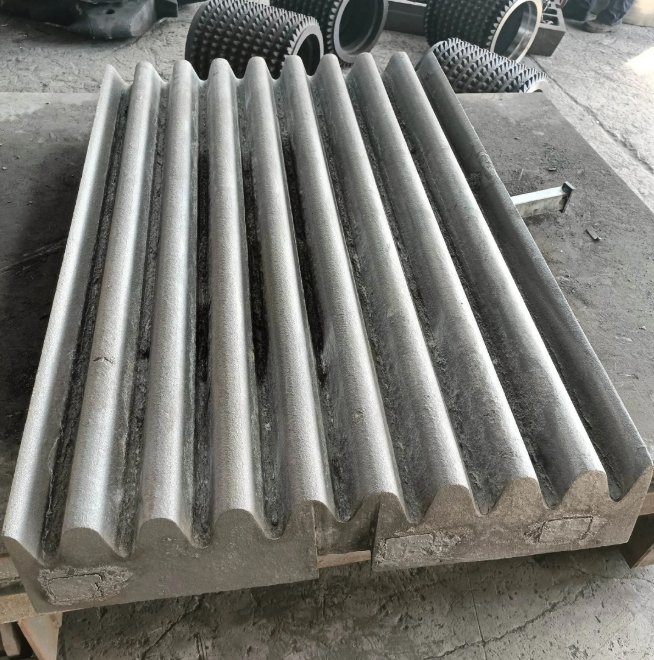
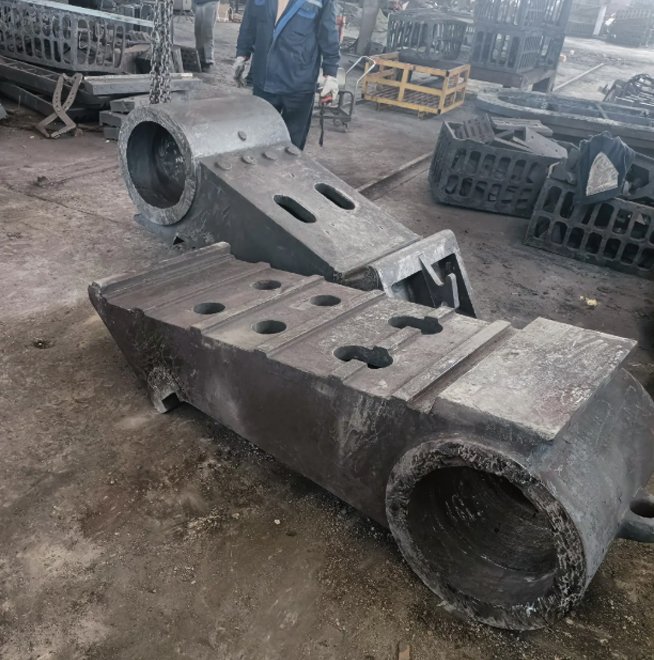
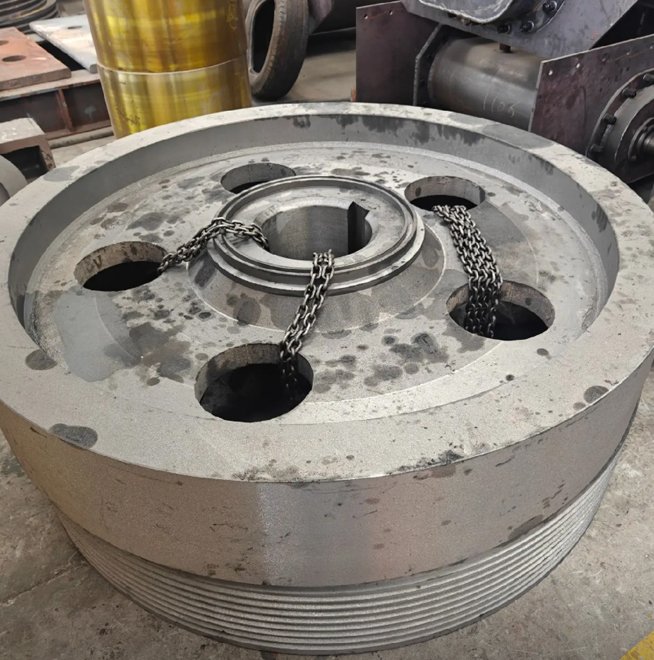
The key components of a jaw crusher determine the equipment’s performance, durability, and maintenance costs. The following is a detailed explanation of the function and materials of each core component:
| Component Name | Core Function | Material |
| Main Frame | Bears crushing impact force and supports the overall structure | Cast steel / Welded steel plate |
| Fixed Jaw Plate | Fixes the crushing working face | High manganese steel |
| Moving Jaw Plate | Reciprocates and crushes materials | High manganese steel |
| Eccentric Shaft | Power transmission, drives the moving jaw to reciprocate | High carbon alloy steel |
| Flywheel & Pulley | Stores kinetic energy and stabilizes equipment operation | Cast iron |
| Thrust Plate | Transmits power and has mechanical overload protection function | Cast steel |
| Discharge Adjustment Device | Adjusts the bottom discharge gap | Wedge / Hydraulic Component |
The key components of a jaw crusher determine the equipment’s performance, durability, and maintenance costs. The following is a detailed explanation of the function and materials of each core component:
Working Principle
Jaw crushers crush high-hardness ores and rocks through mechanical compression. The periodic reciprocating motion of the moving jaw plate achieves efficient crushing and continuous production. The complete crushing process consists of the following steps:
- Feeding: Large pieces of raw stone, ore, or construction waste enter the crushing chamber through the top feed inlet.
- Power Drive: The motor drives the eccentric shaft to rotate, pushing the moving jaw plate closer to the fixed jaw plate.
- Compression Crushing: The material is repeatedly compressed and bent between the moving and fixed jaws until it is broken into particles that meet the requirements.
- Automatic Discharge: The crushed material is discharged from the bottom discharge outlet under gravity.
- Circulating Crushing: Larger particles remain in the crushing chamber to continue being compressed, ensuring that all material meets the discharge particle size standard.
- Stable Production: With the help of auxiliary equipment such as feeders and conveyors, the equipment can achieve continuous and stable automated crushing operations.


Main Application Areas
Jaw crushers, with their excellent hard rock crushing capacity and stability, are widely used in mining, quarrying, and construction waste treatment industries, serving as core equipment for primary crushing of various materials.
- Mining Ore Processing: Efficiently crushes various ores such as gold, copper, iron, and manganese, preparing qualified granular raw materials for grinding and beneficiation processes, ensuring stable operation of the beneficiation production line.
- Quarry Aggregate Production: Suitable for crushing hard rocks such as granite, basalt, limestone, and river pebbles, processing them into standard sand and gravel aggregates required for highways, construction, and concrete mixing plants, with uniform particle shape.
- Construction Waste Recycling: Processes waste concrete, bricks, asphalt blocks, etc., producing recycled aggregates that can be directly used for foundation backfilling and road subbase, contributing to resource recycling.
- Industrial Bulk Material Crushing: Suitable for processing non-metallic bulk materials such as coal, slag, and cement raw materials, meeting the raw material preparation needs of industrial scenarios such as power plants and cement plants.
- Crushing in remote locations: Optional diesel power, no external power supply required, can be put into operation directly in mountainous mines and field construction sites without stable power supply.
The Role of Jaw Crusher in a Production Line
The jaw crusher is the first core piece of equipment in a crushing production line, responsible for the primary crushing of raw ore. It crushes large stones into medium-sized materials that can be directly processed by downstream equipment, ensuring the stable operation of the entire production line.
Its robust structure and efficient crushing chamber design allow it to adapt to materials of various hardnesses and complex working conditions, ensuring smooth operation, simple maintenance, and significantly reduced energy consumption.
Simultaneously, it effectively reduces the load on downstream equipment such as cone crushers and impact crushers, minimizing wear and extending equipment life, helping mines and quarries achieve high-yield, high-efficiency, and low-cost production.
What equipment is used in conjunction with a jaw crusher?
In a complete crushing production line, a jaw crusher does not operate independently. It needs to work in conjunction with multiple types of equipment to achieve efficient and stable material handling. The following are its core supporting equipment and their functions:
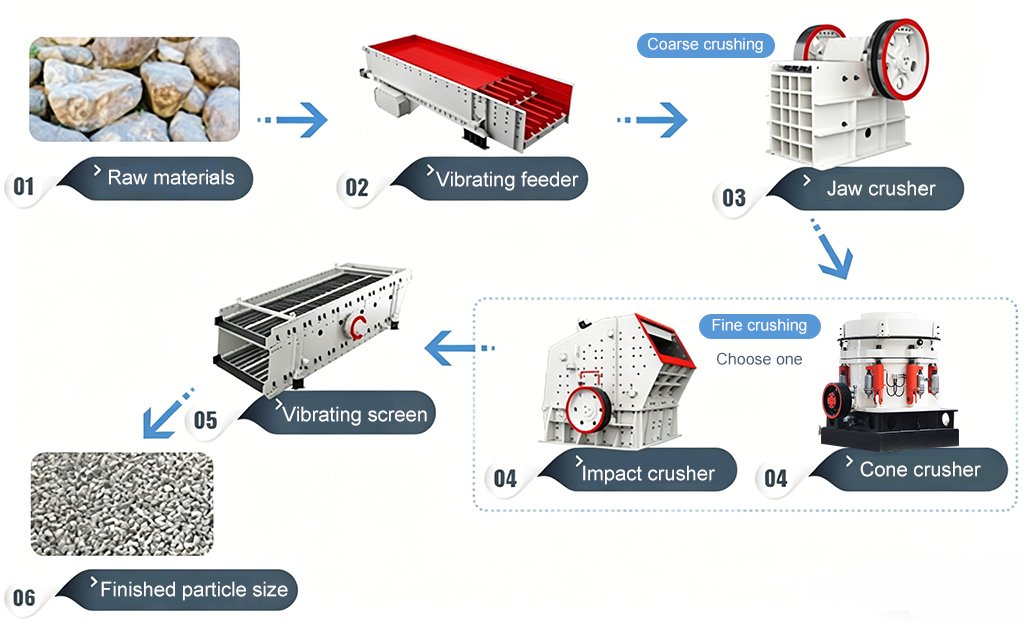
- Vibrating feeder: Evenly and continuously feeds raw materials into the jaw crusher, preventing blockages caused by excessive feeding and ensuring crushing efficiency and equipment safety.
- Vibrating screen/circular vibrating screen: Precisely classifies the jaw crusher output. Large particles are returned for secondary crushing, while qualified particles enter the finished product bin or the next process, ensuring the finished aggregate meets standards.
- Secondary crushing equipment: Such as impact crushers, cone crushers, or hammer crushers, further crush medium-sized materials from the jaw crusher to the user-required finished product particle size, completing the medium and fine crushing process of the entire production line.
- Conveying equipment: Belt conveyors or screw conveyors are responsible for transporting materials between different equipment, ensuring smooth operation of the crushing, screening, and finished product processes and reducing manual intervention.
- Dust removal system: Collects dust generated during the crushing process, improving the workshop working environment while protecting equipment from dust corrosion and ensuring the health and safety of operators.
Technical Parameters of Jaw Crusher(PE Standard Series)
| Model | Feed Port Size (mm) | Maximum Feed Particle Size (mm) | Discharge Port Adjustment Range (mm) | Processing Capacity(t/h) | Eccentric Shaft Speed(r/min) | Motor Power(kw) | Overall Dimensions (Length × Width × Height) (mm) |
| PE 150×250 | 150×250 | 125 | 10-40 | 1-3 | 268 | 4P 5.5 | 760×700×860 |
| PE 200×300 | 200×300 | 180 | 15-50 | 2-6 | 260 | 4P 7.5 | 915×780×990 |
| PE 200×350 | 200×350 | 180 | 18-60 | 3-10 | 276 | 4P 11 | 1000×914×1112 |
| PE 250×400 | 250×400 | 210 | 20-70 | 5-21 | 300 | 6P 15 | 1100×1032×1285 |
| PE 400×600 | 400×600 | 340 | 40-100 | 16-64 | 270 | 6P 30 | 1623×1736×1615 |
| PE 500×750 | 500×750 | 425 | 50-100 | 40-110 | 268 | 6P 55 | 1920×1850×1920 |
| PE 600×750 | 600×750 | 500 | 150-200 | 80-240 | 268 | 6P 55 | 2020×1850×1920 |
| PE 600×900 | 600×900 | 500 | 65-160 | 50-160 | 254 | 6P 75 | 2530×1900×2340 |
| PE 750×1060 | 750×1060 | 630 | 80-180 | 110-320 | 245 | 8P 110 | 2680×2380×2785 |
| PE 900×1200 | 900×1200 | 750 | 100-200 | 220-380 | 208 | 8P 132 | 3470×2876×3330 |
| PE 1200×1500 | 1200×1500 | 1020 | 150-350 | 400-1000 | 180 | 8P 160-245 | 4850×3220×3680 |
| PE 1500×1800 | 1500×1800 | 1200 | 220-350 | 500-1200 | 180 | 8P 280-380 | 5160×3660×4248 |
| PEX 150×750 | 150×750 | 120 | 18-48 | 8-25 | 320 | 4P 15 | 1170×1575×1030 |
| PEX 250×750 | 250×750 | 210 | 25-60 | 13-35 | 320 | 6P 22 | 1550×1730×1470 |
| PEX 250×1000 | 250×1000 | 210 | 25-60 | 16-52 | 330 | 6P 30 | 1580×2006×1390 |
| PEX 250×1200 | 250×1200 | 210 | 25-60 | 20-61 | 330 | 6P 37 | 1780×2214×1430 |
| PEX 300×1300 | 300×1300 | 250 | 20-90 | 16-105 | 300 | 6P 55 | 2210×2320×1723 |
How to Choose a Crusher? Key Factors and Selection Guide
When selecting a jaw crusher, a comprehensive assessment based on material characteristics, production needs, and site conditions is necessary to choose the appropriate model and ensure the efficient and stable operation of the production line. The following are key factors to consider during selection:
- Material Hardness: For crushing hard rocks such as granite and basalt, heavy-duty PEX/CJ series jaw crushers are preferred; for medium-soft stones such as limestone and river pebbles, conventional models can be used, balancing efficiency and cost.
- Feed Size: The maximum size of the raw stone should ideally not exceed 90% of the crusher’s feed opening size to avoid material blockage and equipment damage, ensuring smooth feeding.
- Hourly Output Requirements: Match the appropriate model to the production line’s target hourly processing capacity to avoid oversized or undersized equipment, which could lead to greater losses.
- Discharge Size: The jaw crusher’s discharge gap can be adjusted according to the finished aggregate size and can be paired with corresponding secondary crushing equipment to meet different finished product specifications.
- Site conditions: For mountainous areas and field construction sites without stable power supply, diesel-powered jaw crushers can be selected; for scenarios with complex terrain and frequent relocation, mobile jaw crushers are recommended.


How to Adjust the Discharge Size of a Crusher
The discharge particle size of a crusher directly affects the efficiency of downstream processes and the quality of the finished product. Proper adjustment can meet different production needs.
- Adjusting the discharge opening size: Control the discharge particle size by adjusting the gap between the fixed plate and the moving jaw plate.
- Adjusting the crushing chamber design: Different crushing chamber designs (deep chamber, shallow chamber, high chamber) will affect the material crushing ratio and discharge particle size.
- Adjusting the screening or secondary classification system: Adjust the discharge particle size range by adjusting the screen aperture; large particles can be returned for secondary crushing.
- Controlling the feed rate and feed uniformity: Use a vibrating feeder to ensure continuous and uniform feeding, stabilizing the discharge particle size.
Common Faults and Solutions
- Excessive Vibration and Severe Abnormal Noise: Caused by loose bolts or flywheel imbalance; Solution: Tighten bolts and correct flywheel balance.
- Decreased Production Output: Caused by severe jaw plate wear or improper discharge clearance; Solution: Replace wear-resistant parts and readjust the discharge port.
- Material Blockage in the Chamber: Caused by excessive feeding speed or wet, viscous material; Solution: Stop feeding and manually remove blockage.
- Overheating of Bearings: Caused by insufficient lubrication or shaft misalignment; Solution: Add lubricating oil and correct installation clearance.
- Thrust Plate Breakage: Caused by overload operation or hard objects entering the chamber; Solution: Clean impurities and strictly control the feed rate.
Jaw crusher compared with other crushers
| Equipment Type | Applicable Materials & Working Conditions | Finished Particle Size & Shape | Structure & Maintenance | Core Advantages |
| Jaw Crusher | Large, hard materials, primary crushing | Adjustable particle size, preferably long | Robust structure, simple maintenance | First choice for primary crushing, robust and durable, easy to operate |
| Impact Crusher | Medium-soft materials, secondary or finished sand | Good particle shape, medium particle size | Complex structure, many wearing parts | Good particle shape, suitable for finished sand and gravel |
| Cone Crusher | High-hardness materials, secondary or tertiary crushing | Uniform particle size, high output | Precision parts, requires regular maintenance | High efficiency and high output, uniform particle size |
| Hammer Crusher | Medium-hard materials, large crushing ratio | Uneven output | Easily wears, requires frequent hammer replacement | Large crushing ratio, simple structure |
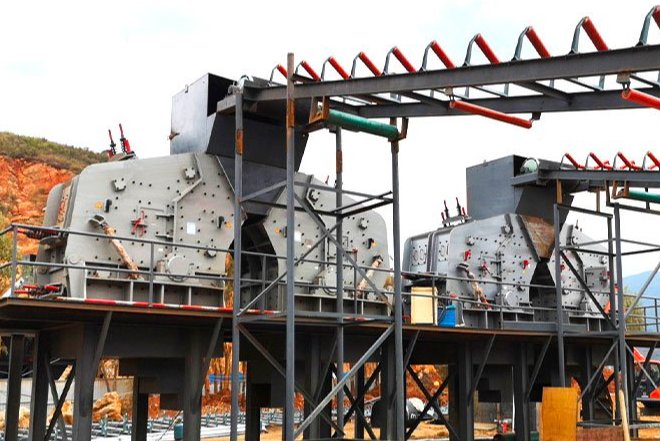
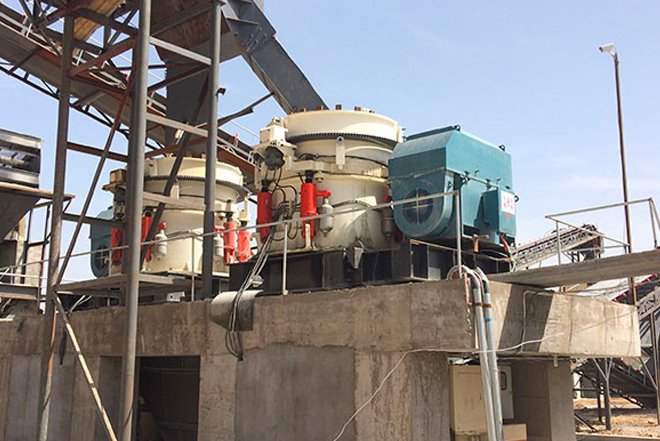
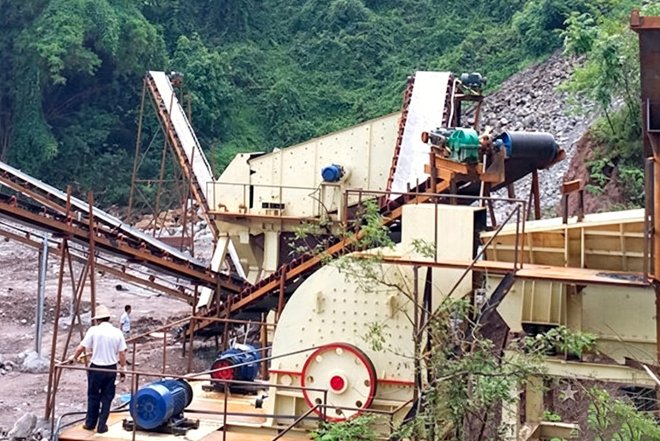
Why Choose CHUNLEI Crusher?
As a professional manufacturer of mining crushing equipment, we offer a comprehensive one-stop service, from R&D and production to quality inspection, customized solutions, and after-sales support. This is a key reason why many domestic and international clients prioritize our crushers:
We have over 20 years of professional experience in manufacturing mining crushing equipment, possessing mature production processes and extensive practical project experience.
- Strict quality inspection before shipment; each piece of equipment passes inspection.
- Customized crushing production line solutions for global clients.
- One-stop service including overseas installation, commissioning, and operation training.
- Factory direct sales, no middlemen, higher cost-effectiveness.
- Equipment adaptable to various harsh mining conditions, stable and reliable operation.
FAQ
Q1: What materials can a jaw crusher process?
A: Suitable for various hard rocks, ores, and construction waste with a compressive strength ≤320MPa.
Q2: What is the difference between PE and PEX jaw crushers?
A: PE is a coarse crusher type; PEX is a fine crusher type, with a smaller discharge gap and finer finished product.
Q3: What is the typical service life of the jaw plates?
A: It depends on the material hardness and operating time, with a typical service life of 3–6 months.
Q4: Can it crush concrete construction waste?
A: Yes, it is currently the mainstream equipment for construction waste recycling.
Q5: Do you support equipment customization and on-site installation?
A: We support non-standard customization, overall production line planning, and provide global on-site installation guidance services.
Q: Can a jaw crusher handle wet materials?
A: Not recommended. When the material has a high moisture or mud content, it is easy to clog the crushing chamber, leading to decreased efficiency or even shutdown. If it is necessary to process wet material, it is recommended to add screening equipment at the front end to remove fine materials and mud first.
Related Products —
Mud and Stone Separator
Mud and stone separator, as the name suggests, is a device to separate mud and stone, also called mud and stone separating and screening equipment. Roller screen is made of multiple shafts, divided into multiple segments to drive the mat…
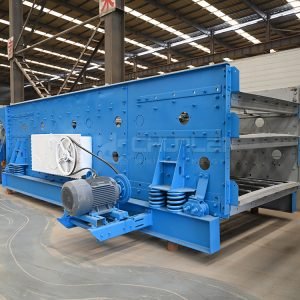
Three-shaft horizontal vibrating screen
A variety of models are available | Get the free price list! Three-shaft horizontal vibrating screen also called three-axis horizontal vibrating screen sieve , is a new type of vibrating screen with multi-layer num…
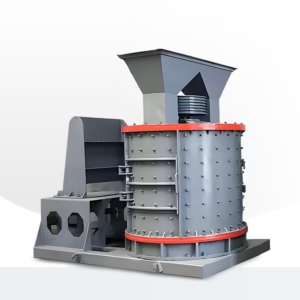
Combination Crusher
Combination Crusher is a new product optimized and designed based on our company’s PEL vertical compound crusher and combined with domestic and foreign fine crushing technology. The vertical compound crusher, also kno…
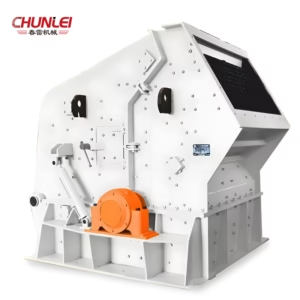
Impact Crusher
An impact crusher is a core piece of equipment in sand and gravel aggregate production for medium and fine crushing and shaping. It uses a high-speed rotor to drive hammer plates to impact the material, and the repeated…
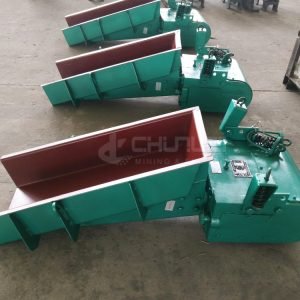
Electromagnetic vibrating feeder
A variety of models are available | Get the free price list! Electromagnetic vibrating feeder is a kind of automated equipment that utilizes electromagnetic vibration principle to drive the continuous, uniform or q…
loading…
已经是到最后一篇内容了!