 Chunlei Mining Machinery


Cone Crusher
Cone Crusher utilize a layered crushing principle, producing well-shaped particles and reducing the generation of needle-like and flaky particles. They are typically used as a secondary or tertiary crushing process. Their characteristics include robust structure, high production efficiency, and ease of operation.
- Feed size: ≤350mm
- Capacity:45-1200t/h
- Application areas: applied to mining, building materials, transportation, energy, chemical industry and other industries.
What is Cone Crusher?
A cone crusher is a type of medium-fine crushing equipment that uses a layered compression mechanism. Its core components include a fixed cone, a moving cone, an eccentric sleeve, and a drive system. A motor drives the eccentric sleeve to rotate, while the moving cone performs a reciprocating circular motion. This repeatedly compresses, grinds, and layers the hard rock falling into the crushing chamber, processing large pieces of hard rock (≤300mm) into cubic aggregates (5–50mm). It is a core piece of equipment in mines and sand and gravel plants.
Unlike impact crushers, which are also medium-fine crushing equipment, cone crushers are more suitable for processing hard rock, while impact crushers are suitable for soft materials and are used in combination for mixed processing conditions.
Core Structure and Key Components
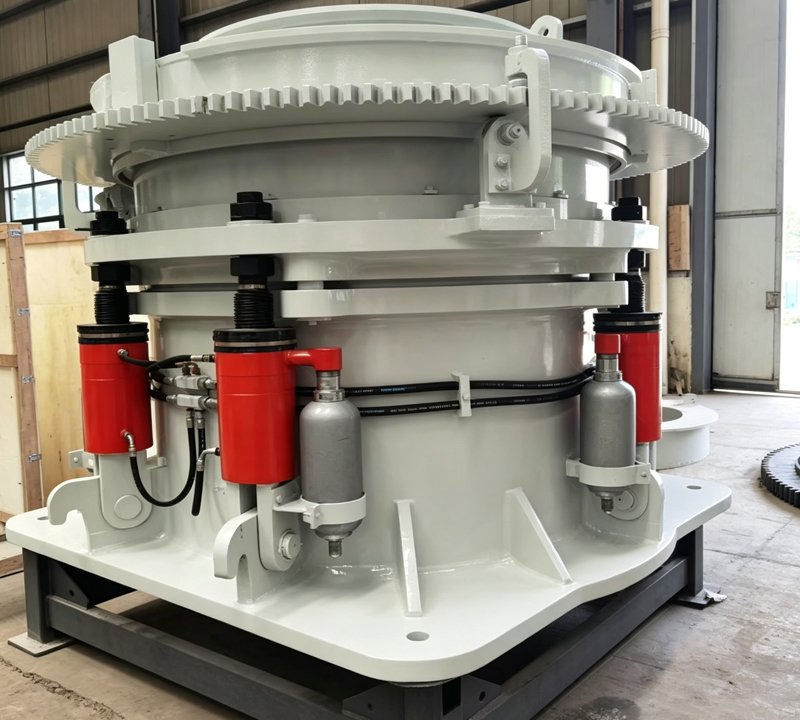
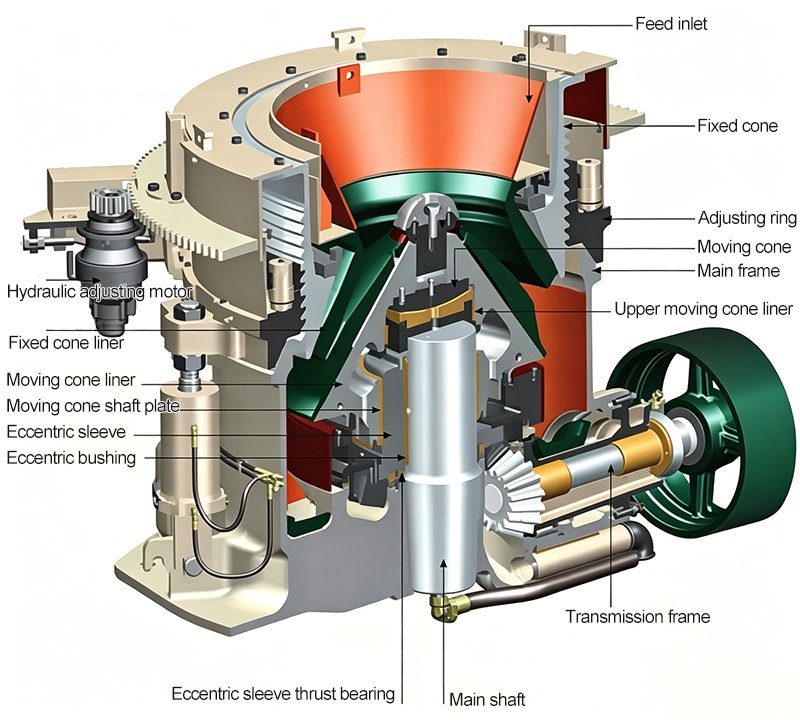
The core structure of the cone crusher consists of a high-strength cast steel frame, moving cone, fixed cone, eccentric bushing, hydraulic system, and transmission components. Each part is designed for heavy-duty hard rock conditions, ensuring long-term stable operation.
- The main frame is made of high-strength cast steel or thick steel plate welded together, forming a single piece with extremely high rigidity, capable of withstanding all crushing impact forces and providing stable support.
- The moving cone (jaw liner) is the core rotating crushing component, cast from high-manganese steel or alloy wear-resistant steel. It is a key component for material crushing and is also a wear part. Its service life can reach 8–12 months under granite conditions and 15–24 months under limestone conditions.
- The fixed cone (concave liner) is the fixed crushing wall, also made of thickened high-manganese steel wear-resistant material. It works in conjunction with the moving cone, is easy to replace, and reduces maintenance costs.
- The eccentric bushing and main shaft are forged from high-toughness alloy steel, ensuring stable power transmission, smooth operation with low vibration, and precise oscillation of the crushing chamber.
- The hydraulic adjustment system enables one-button adjustment of the discharge gap, intelligent overload protection, and automatic reset, allowing for precise material control without machine downtime, significantly reducing downtime losses and adapting to different particle size production needs.
- The transmission system consists of a motor, coupling, and high-precision gears, offering high transmission efficiency, low noise, and low energy consumption, ensuring stable power output and suitability for long-term continuous operation.
Mainstream Types of Cone Crusher
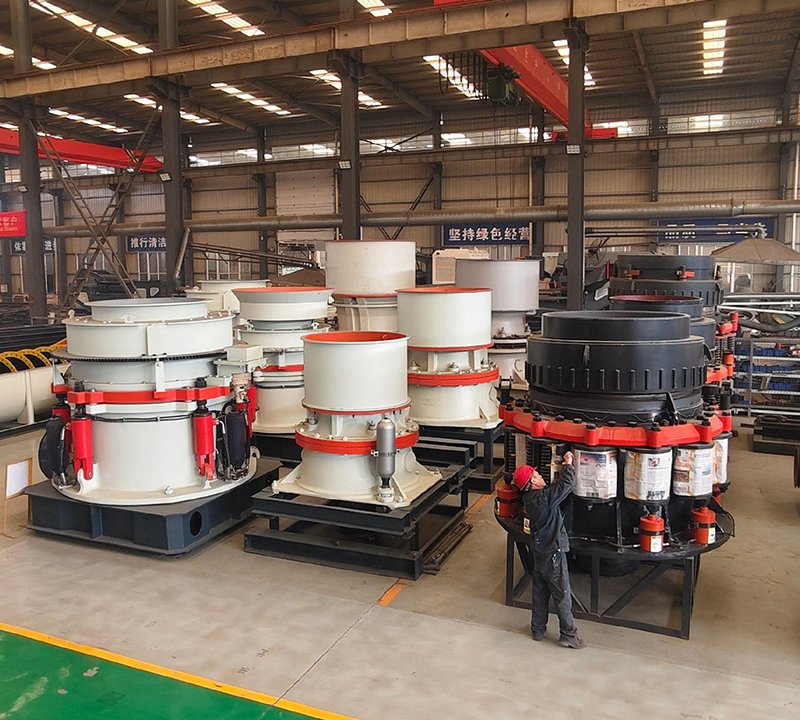
Cone crushers can be mainly classified into the following categories:
Spring Cone Crusher
The spring cone crusher is a classic and traditional model, characterized by its simple structure, low cost, and low maintenance threshold. It has long served small to medium-sized mines, low-capacity hard rock projects with limited budgets. It uses a set of high-strength springs to protect the crusher from damage by debris (such as metal fragments).
Its core advantages are its affordable price, low cost of wearing parts, and convenient daily maintenance. Its shortcomings include slow adjustment efficiency, weak overload protection, relatively low capacity, and relatively ordinary finished product particle shape.
Single-Cylinder Hydraulic Cone Crusher
The single-cylinder hydraulic cone crusher is an improved design based on the traditional spring cone crusher. It features a single hydraulic cylinder and a fully hydraulic adjustment system, offering a high degree of automation and convenient adjustment. It is currently the mainstream choice for small to medium-sized hard rock projects.
Key advantages include: one-button discharge gap adjustment, intelligent overload protection, stable and low-noise operation, excellent finished product particle shape, and high cost-effectiveness. It is suitable for granite, basalt, iron ore, and mobile crushing plants, making it a high-performance, cost-effective choice for small to medium-capacity hard rock projects.
Multi-cylinder hydraulic cone crusher
This is currently the most widely used type of equipment. It employs a multi-cylinder hydraulic system, a high-strength frame, and a deep-cavity lamination design, making it suitable for extreme working conditions. It combines the advantages of spring cone crushers and Simons cone crushers, and optimizes upon them.
Its advantages are concentrated in hard rock heavy-duty scenarios: strong crushing force, sufficient lamination, cubic aggregate content can reach over 90%, long wear-resistant life, and can operate continuously under heavy load for 24 hours. Its disadvantages are a higher equipment price, the need for professional technicians for maintenance, and a larger footprint. It is only recommended for large granite mines, iron ore beneficiation, and other high-grade aggregate projects.
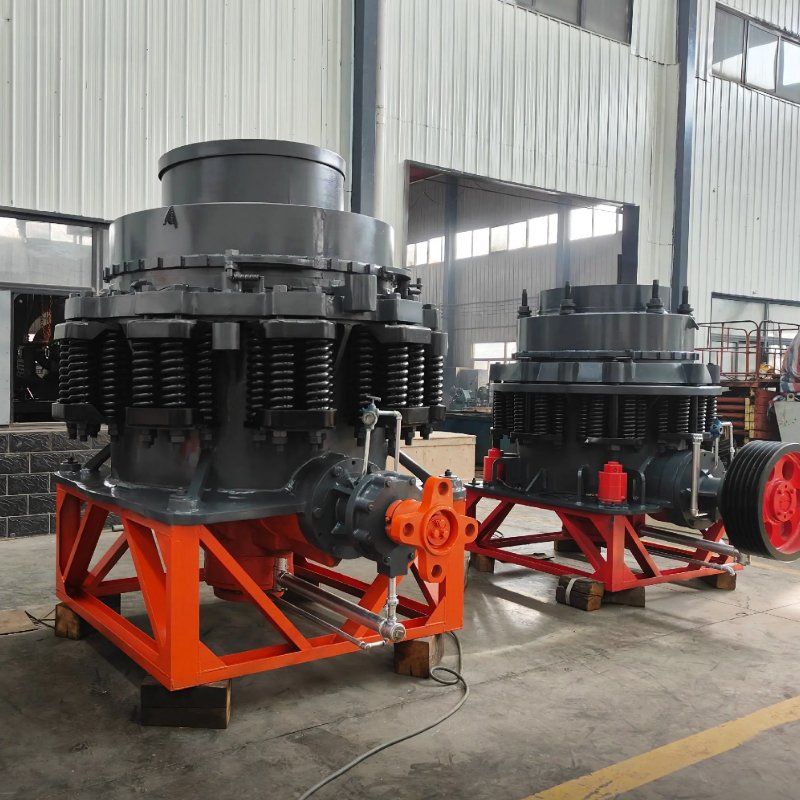
Capacity:18-650 TPH
Inlet Size:280mm
Min. Output Size:3-60mm

Capacity:48-500 TPH
Inlet Size:270mm
Min. Output Size:6mm
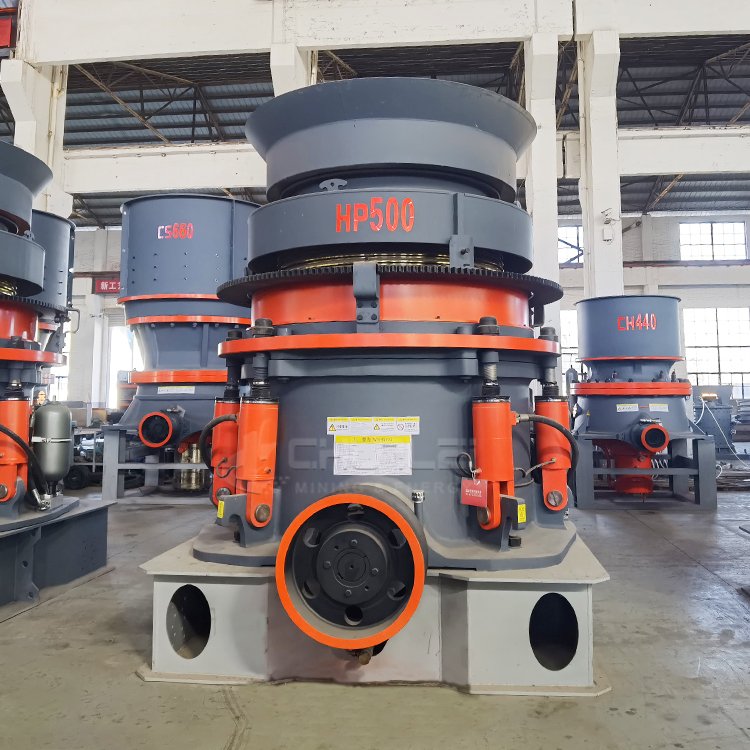
Capacity:90-1200 TPH
Inlet Size:20-353mm
Min. Output Size:6mm
Working Principle
The cone crusher utilizes the principle of layered compression to crush hard rock, ensuring a continuous, stable, efficient, and uniform process.
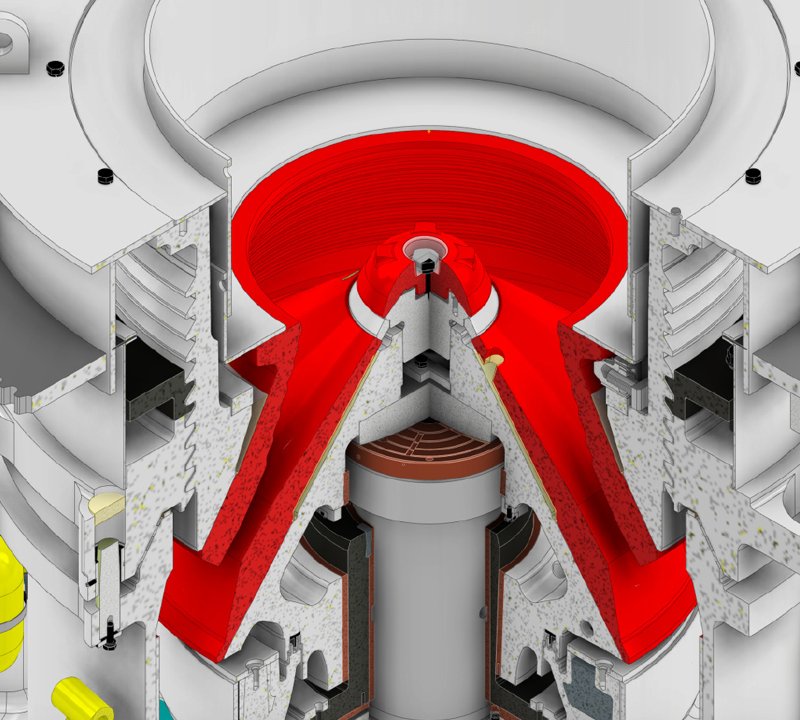
Hard rock enters the crushing chamber through the top feed hopper. A motor drives the eccentric sleeve to rotate at high speed, influencing the main shaft and moving cone to perform a circular oscillating motion. This applies strong compressive force to the hard rock within the chamber, achieving multiple crushing processes including layering, friction, and shearing. As the moving cone moves away from the fixed cone, the crushed material falls under gravity and enters the next crushing chamber for further processing.
The material is crushed progressively from top to bottom and from coarse to fine. Qualified particles are discharged from the bottom outlet, while larger particles remain within the chamber for further recycling and crushing, ensuring uniform output. The final product is cubic aggregate with excellent particle shape, making it an ideal piece of equipment for hard rock crushing.

What types of materials are cone crushers suitable for processing?
Cone crushers are primarily designed for medium-hard to extremely hard materials. They employ a layered compression crushing process, offering wear resistance, durability, stable production capacity, and producing high-quality, uniformly shaped finished products.
- High-hardness rocks: Granite, basalt, diabase, river pebbles, quartzite, etc., suitable for use as high-quality aggregate in high-speed rail and highway construction.
- Metal ores: Iron ore, copper ore, manganese ore, gold ore, etc., used for fine crushing in mineral processing lines to reduce grinding load.
- Industrial recycled materials: Construction waste, asphalt blocks, slag, steel slag, furnace slag, etc., which can be processed and used as backfill aggregate for roadbeds, achieving recycling.
Can cone crushers handle wet or sticky materials?
Cone crushers are not suitable for handling high-moisture, high-sticky materials. These materials easily stick to the crusher chamber, causing blockages, reducing output, accelerating wear, and in severe cases, leading to equipment jamming.
- They can handle small quantities of: materials with a moisture content <5%, slightly damp, and not sticky (such as dry, hard ores, granite, and basalt).
- They are not recommended for handling: materials with a moisture content >8%, highly sticky, and prone to caking (such as clay, wet mud, wet coal, and high-moisture construction waste).
- Special cases: For small quantities of wet material, drying, pre-screening, and forced feeding can be used to alleviate blockages, but this is inefficient and has high maintenance costs. Impact crushers or hammer crushers are more suitable alternatives.
How to Choose the Right Model Based on Production Capacity?
When selecting a cone crusher model, production capacity is the primary decision-making factor. It should be comprehensively matched with material hardness, feed size, finished product particle size, and operational stability. Otherwise, it’s easy to encounter situations where “using a large machine for a small scale wastes costs, or using a small machine for a large scale results in insufficient production capacity.”
Matching the Model According to Production Capacity
- Small production lines (50–150 tons per hour) should prioritize single-cylinder hydraulic cone crushers. These models are compact, cost-effective, and easy to adjust, making them suitable for small to medium-sized granite plants, quarries, and construction waste recycling lines.
- Medium production lines (150–300 tons per hour) can utilize a combination of single-cylinder and multi-cylinder cone crushers. Multi-cylinder crushers are preferred when the proportion of hard rock is high and good particle shape is required; larger single-cylinder crushers are chosen for those prioritizing cost-effectiveness.
- Large production lines (300–600 tons per hour) must use multi-cylinder hydraulic cone crushers. Large-scale mines and high-grade aggregate projects have extremely high requirements for output, particle shape, and stability. Multi-cylinder crushers, with their strong crushing force, sufficient layering, and 24-hour heavy-load operation without pressure, are the mainstay of large-scale hard rock production.
- Ultra-large production lines (over 600 tons per hour) require large-diameter multi-cylinder cone crushers or single-cylinder multi-machine parallel operation, such as H680, H880, and SH660, to ensure capacity and stability through the coordinated operation of multiple machines.
Adjusting the model based on material hardness
- For the same output, hard rock (granite, basalt) requires a larger-sized crusher because hard rock has high crushing resistance and rapid wear; smaller crushers are prone to overloading and failing to meet output targets. For example, for the same 200 tons per hour, an SH440 is sufficient for limestone, while an HP300 or a similar multi-cylinder crusher is recommended for granite.
- For soft materials (limestone, weathered rock), a standard model can be selected based on standard output, resulting in lower costs and better economic efficiency.
Feed size determines model size
The maximum feed opening diameter of the model must be larger than the actual feed size; otherwise, material blockage will occur. For example, if the feed size is 250mm, a model with a feed size ≥250mm must be selected (such as SH440 or HP300). Otherwise, the equipment will be completely unusable; this is a key performance indicator for model selection.
Finished product particle size affects capacity and model
Fineer output results in lower output. For example, for the same model, a 30mm output might have a capacity of 250 tons, but adjusting it to 10mm could reduce it to 180 tons. If fine aggregate is required, a larger model or a finer cavity type is needed to balance output and particle size.
In short, output depends on the hardness of the material, feed opening diameter depends on its adequacy, particle size depends on the fineness of the cavity type, and operating stability depends on the stability of the system. By matching these four factors well, a stable, high-output, and cost-effective cone crusher model can be selected.
How to Control the Output and Finished Particle Size of a Cone Crusher?
Controlling the output and finished particle size of a cone crusher relies on adjusting the discharge port gap: a larger gap increases output but results in coarser particle size, while a smaller gap decreases output and results in finer particle size. Simultaneously, selecting a suitable crushing chamber type is crucial; a coarse chamber produces a larger output and coarser material, while a fine chamber produces a finer material and slightly lower output. Uniform and stable feeding is essential to avoid blockages or idling. Fine-tuning parameters based on material hardness is also important; harder rock requires a slightly larger gap and a medium-coarse chamber, while softer rock can benefit from a smaller gap and a finer chamber. This will allow for stable control of both output and particle size.
Why are cone crushers indispensable in production lines?
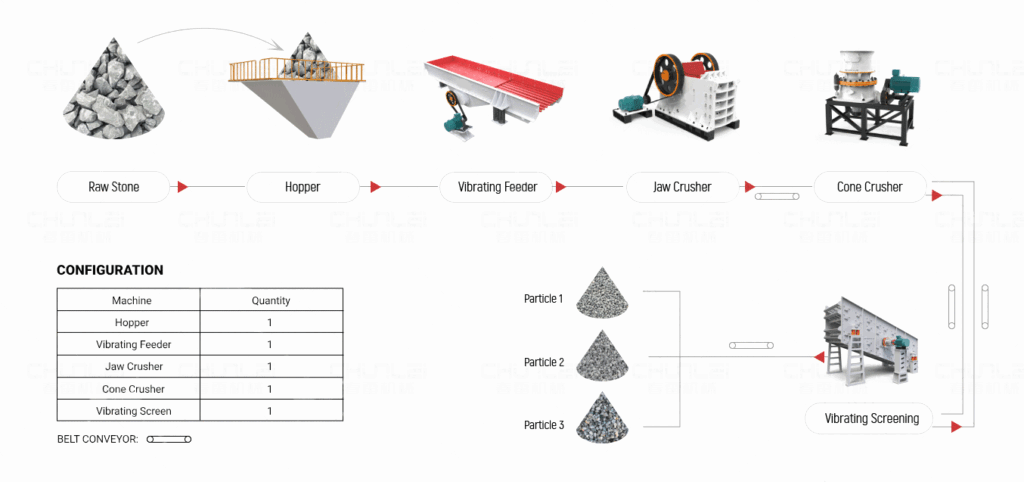
In sand and gravel and ore crushing production lines, cone crushers are the core, irreplaceable, and crucial medium and fine crushing equipment, bridging the gap between upstream and downstream processes.
Specifically designed for high-hardness stones such as granite, basalt, and iron ore, they boast strong compressive crushing capabilities, wear resistance, and durability. They can process large stones coarsely crushed by jaw crushers into uniformly sized, square-shaped standard aggregates. Compared to impact crushers, they are more suitable for long-term continuous operation in hard rock, with lower wear, more stable output, and lower operating costs.
Their discharge port is flexibly adjustable to adapt to different engineering material requirements. They can produce various sizes of crushed stone in stages and provide qualified feed for subsequent sand making. They can also be flexibly adapted to fixed production lines and mobile crushing stations. Cone crushers are the core equipment for maintaining stable output throughout the entire production line.
Technical Parameters of Cone Crusher
| Model | Cavity | Open Edge Feed Size (mm) | Tight Edge Feed Size(mm) | Minimum Discharge Size(mm) | Capacity(t/h) | Maximum installed power(kw) |
| HPG100 | C1(Ultra-coarse) | 175 | 140 | 19 | 45-100 | 90 |
| C2(Coarse) | 125 | 105 | 13 | |||
| M(Medium) | 100 | 70 | 10 | |||
| F1(Fine) | 71 | 50 | 9 | |||
| F2(Super fine) | 33 | 20 | 6 | |||
| HPG200 | C2(Coarse) | 235 | 190 | 19 | 65-250 | 160 |
| M(Medium) | 171 | 120 | 16 | |||
| F1(Fine) | 150 | 95 | 13 | |||
| F2(Super fine) | 116 | 70 | 8 | |||
| HPG300 | C1(Ultra-coarse) | 265 | 230 | 25 | 85-440 | 220 |
| C2(Coarse) | 240 | 210 | 20 | |||
| M(Medium) | 190 | 150 | 15 | |||
| F1(Fine) | 145 | 105 | 11 | |||
| F2(Super fine) | 120 | 80 | 8 | |||
| HPG400 | C1(Ultra-coarse) | 360 | 290 | 30 | 135-625 | 315 |
| C2(Coarse) | 310 | 250 | 25 | |||
| M(Medium) | 260 | 196 | 20 | |||
| F1(Fine) | 182 | 110 | 13 | |||
| F2(Super fine) | 135 | 90 | 10 | |||
| HPG500 | C1(Ultra-coarse) | 370 | 330 | 38 | 200-790 | 400 |
| C2(Coarse) | 320 | 290 | 28 | |||
| M(Medium) | 245 | 210 | 22 | |||
| F1(Fine) | 180 | 130 | 13 | |||
| F2(Super fine) | 150 | 95 | 10 | |||
| HPG800 | C1(Ultra-coarse) | 450 | 352 | 38 | 265-1200 | 630 |
| C2(Coarse) | 373 | 298 | 32 | |||
| M(Medium) | 340 | 275 | 25 | |||
| F1(Fine) | 280 | 230 | 16 | |||
| F2(Super fine) | 235 | 150 | 10 |
Note: The output will vary depending on different materials, feed particle size and other factors.
Customer Case Studies
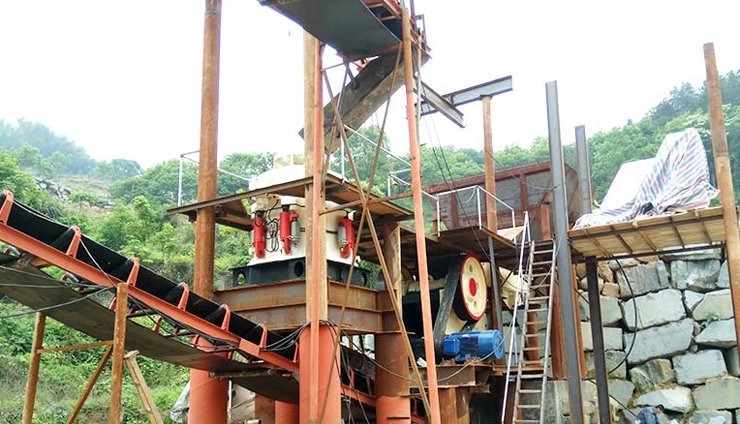
A large granite mine, equipped with a PE750×1060 jaw crusher + HP300 multi-cylinder cone crusher, achieving a production capacity of 200 tons per hour, outputting 10–30mm high-quality aggregate with a cubic content ≥92%, 24-hour stable operation, and a 10-month liner life, suitable for large-scale hard rock production.
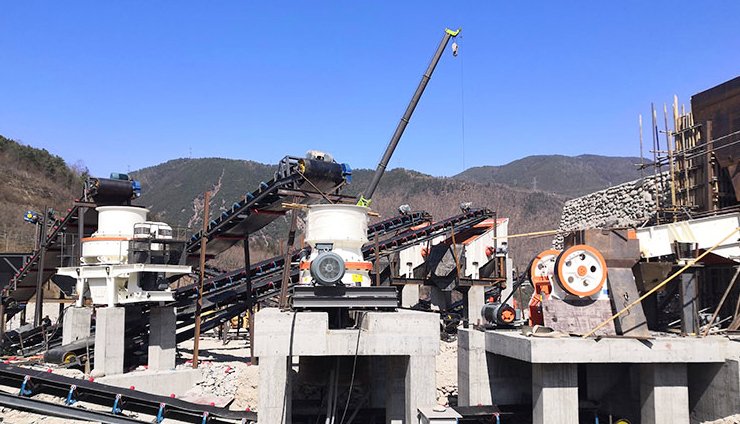
Another configuration, equipped with a PE600×900 jaw crusher + SH440 single-cylinder cone crusher, achieving a production capacity of 120 tons per hour, outputting 12–25mm aggregate, providing uniform fine crushing, and increasing mineral processing efficiency by 20%, suitable for the pre-processing fine crushing requirements of metal ores.
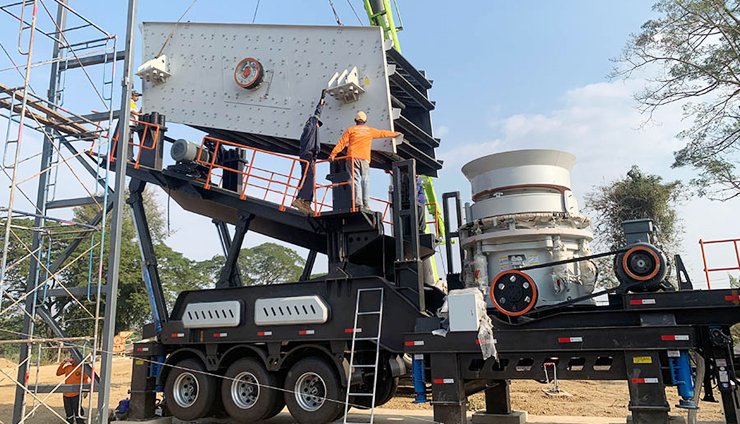
Utilizing a mobile jaw crusher + mobile cone crusher, producing 80 tons per hour, 15–35mm recycled aggregate, requiring no infrastructure construction, flexible relocation, and achieving compliant construction waste recycling, suitable for decentralized demolition and crushing scenarios.
Cone Crusher Prices
The price of cone crushers varies considerably, primarily depending on the equipment size, processing capacity, technical configuration, brand strength, and condition (new or used). There is no fixed price.
Key Influencing Factors
- Size and Capacity: Larger equipment with higher hourly output requires more materials and has higher manufacturing costs, resulting in a higher price.
- Technical Configuration: Advanced features such as hydraulic adjustment, automated control, and intelligent monitoring improve equipment performance but also increase costs.
- Brand Strength: Leading brands offer better guarantees in technology, processes, quality, and after-sales service, and their prices are usually higher than those of ordinary manufacturers.
- Equipment Condition: New equipment comes with a complete warranty and stable performance; used equipment is cheaper, but wear and tear and remaining service life need to be considered.
For an accurate quote, we recommend contacting us to obtain a customized solution and quotation based on your actual production capacity, material hardness, and output particle size requirements.
What safety designs or functions are included in modern cone crushers?
Modern cone crushers are comprehensively designed with safety protection, overload protection, and intelligent monitoring in mind, significantly reducing operational risks and protecting equipment and personnel safety.
- Hydraulic overload protection: Automatically discharges and quickly resets upon encountering uncrushable hard objects, preventing equipment damage.
- Intelligent monitoring system: Real-time monitoring of oil temperature, oil pressure, vibration, and current; automatically alarms or shuts down in case of abnormalities.
- Emergency stop device: Equipped with emergency stop buttons on the machine body and operating station; one-button power cut-off in emergencies.
- Safety guardrails and covers: Fully enclosed dangerous parts such as transmission lines and pulleys to prevent personnel contact.
- Overload and blockage protection: Automatically reduces speed or stops the machine in case of abnormal feeding or excessive load, preventing jamming.
- Automatic lubrication and temperature control: Intelligent oil supply and oil temperature monitoring prevent overheating and malfunctions caused by dry grinding.
What are the daily maintenance requirements for a cone crusher?
Cone crusher maintenance mainly involves daily inspections, regular maintenance, and replacement of wearing parts. Proper basic maintenance can significantly reduce malfunctions and extend service life.
- Daily Inspections: Check oil temperature, oil level, vibration, abnormal noise, and feed uniformity daily.
- Weekly Maintenance: Tighten external bolts and check the wear of the moving and fixed cone liners.
- Monthly Maintenance: Lubricate bearings, clean debris from the crushing chamber, and calibrate the discharge gap.
- Regular Replacement: Replace liners, seals, and wear parts according to operating conditions.
- Long-Term Protection: Prevent hard objects from entering the chamber, avoid overloading, and protect the hydraulic system.
FAQ
Q: Can a cone crusher be used with a mobile crushing plant?
A: Absolutely. Single-cylinder and multi-cylinder hydraulic cone crushers can be customized into mobile tracked or wheeled units, offering flexible relocation without the need for concrete foundations, suitable for construction site relocation and scattered field mining operations.
Q: Can a cone crusher be used in conjunction with an impact crusher in a production line?
A: Yes, a standard configuration includes a jaw crusher for coarse crushing + a cone crusher for medium and fine crushing of hard rock + an impact crusher for shaping. This combination ensures both square aggregate shape and balanced output and finished product gradation, making it a common choice for high-specification sand and gravel production lines.
Q: What auxiliary equipment is needed when purchasing a cone crusher?
A: Basic equipment includes a feeder, conveyor belt, vibrating screen, magnetic separator, and lubrication station. For enclosed production lines, dust collection equipment can also be added to reduce dust pollution.
Q: Is cone crusher installation complex? Does it require professional on-site commissioning?
A: The overall structure of the machine is mature, and the installation process is standardized. However, for initial wiring, gap adjustment, and lubrication system debugging, it is recommended that the manufacturer’s engineers provide on-site guidance to avoid malfunctions caused by initial misoperation.
Q: How long do the wear parts of a cone crusher typically last, and are they easy to purchase replacements?
A: The main wear parts are the moving cone liner and the fixed cone liner. They can last 8-12 months in hard rock conditions and over 15 months for ordinary stone. The manufacturer can provide original spare parts on a long-term basis; they are universally compatible and easy to replace.
Q: Can a cone crusher be used for sand making in a production line?
A: It is not recommended to use it as the main sand making equipment. Cone crushers are suitable for producing 5-30mm aggregates. If 0-5mm manufactured sand is required, it is recommended to combine it with an impact crusher for a finer finished sand.
Q: What are the power supply and site requirements for operating a cone crusher?
A: It uses standard industrial 380V power supply according to the model. The site only needs to be leveled and hardened. Large models require reserved maintenance space and material storage areas, while mobile models have almost no site infrastructure requirements.
Q: What problems are common when a novice operates a cone crusher, and how can they be avoided?
A: The most common problems are feeding too fast and causing blockage of the chamber, arbitrarily reducing the discharge opening and overloading, and neglecting daily oil checks. As long as you maintain uniform feeding, adjust the gap according to the standard, and insist on daily inspections, you can greatly reduce downtime due to malfunctions.
Related Products —
Impact Crusher
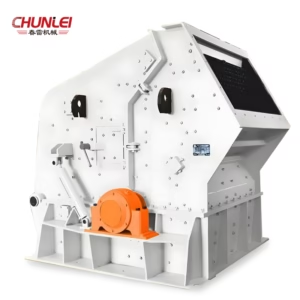
An impact crusher is a core piece of equipment in sand and gravel aggregate production for medium and fine crushing and shaping. It uses a high-speed rotor to drive hammer plates to impact the material, and the repeated…
PE/PEX Jaw Crusher
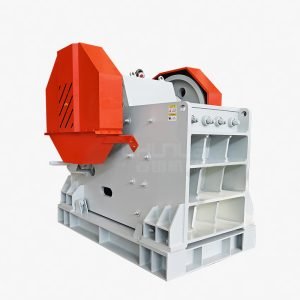
Jaw Crusher is a commonly used ore crushing equipment, widely used in mining, smelting, building materials, highway, railroad, water conservancy and chemical industry and many other industries of the primary crushing equipment, mainly us…
Circular Vibrating Screen
A variety of models are available | Get the free price list! Circular vibrating screens (also called inclined circular motion vibrating screens) are multi-layer high-efficiency screening equipment. Driven by an ecc…
Single Cylinder Cone Crusher
Single Cylinder Cone Crusher, also called Single Bar Hydraulic Cone Crusher, is a medium and fine crusher with hydraulic system to adjust the discharge opening and for overload protection. The single-cylinder hydra…
Vibrating feeder
Vibrating feeder, also known as vibrating feeder, can provide continuous and uniform feeding for crushing machinery and screening of materials, which is widely used in crushing and screening combined equipment in mineral processing, buil…

loading…
已经是到最后一篇内容了!